Cleaner cities
Daily door-to-door collection across 12 divisions of Dindigul keeps waste out of residential streets, markets and drains — and the operation runs 24×7, including at peak load.
City-scale waste operations for Dindigul, and decentralised composting for panchayats — collection, source segregation, processing and disposal.
Understanding
Solid waste management is the systematic handling of municipal waste from collection to final disposal — ensuring environmental sustainability and public health at every step.
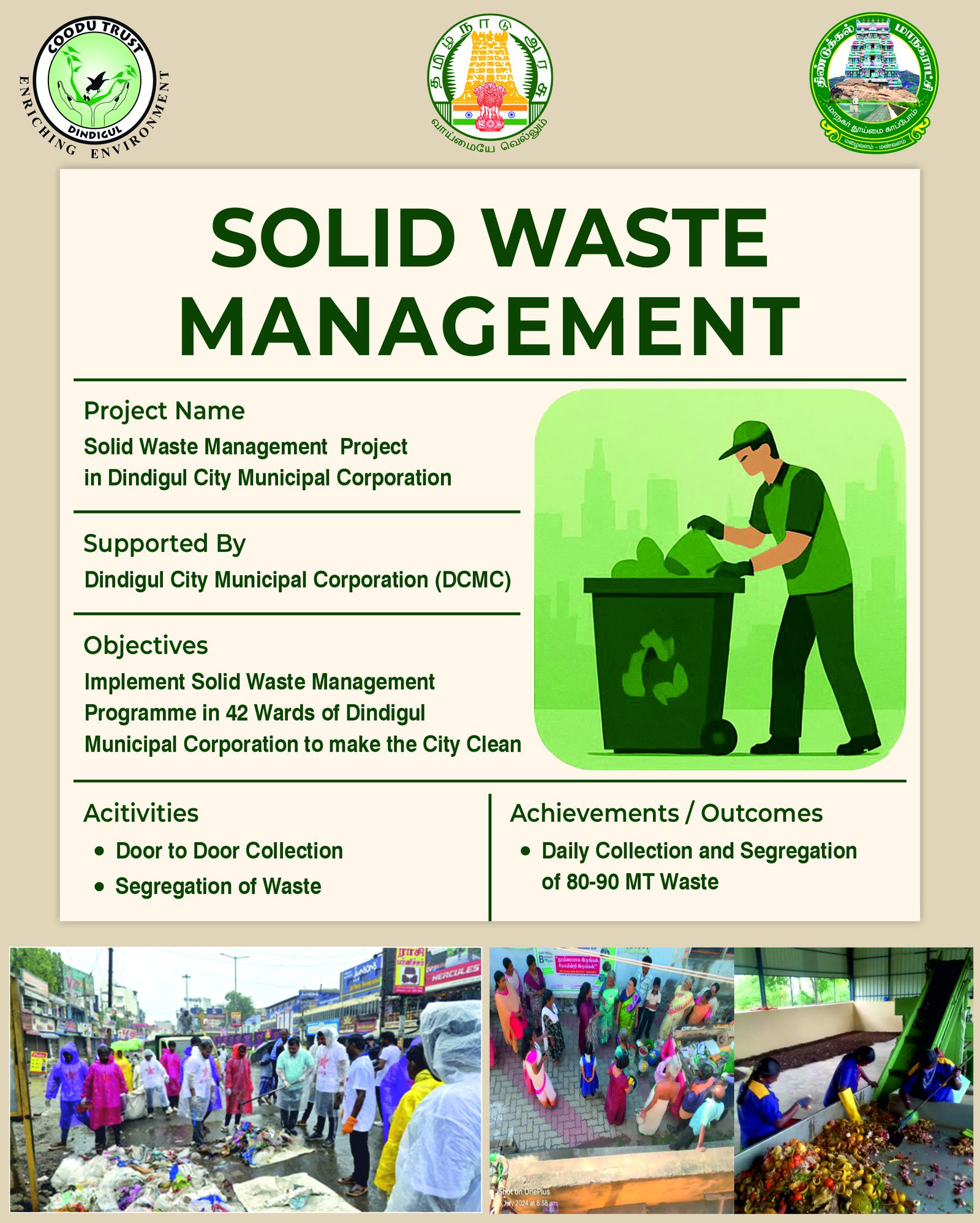
Coodu Trust has been entrusted with the Solid Waste Management programme for the Dindigul City Municipal Corporation. The city is divided into 12 operational divisions, each with its own collection strategy, and a dedicated team of 400 sanitary workers collects door to door from households, streets and markets, segregating waste into degradable and non-degradable at source. An average of 86 tonnes of waste is collected and processed every day, and specialised teams clear silt and garbage from the city’s drains. The operation runs round the clock.
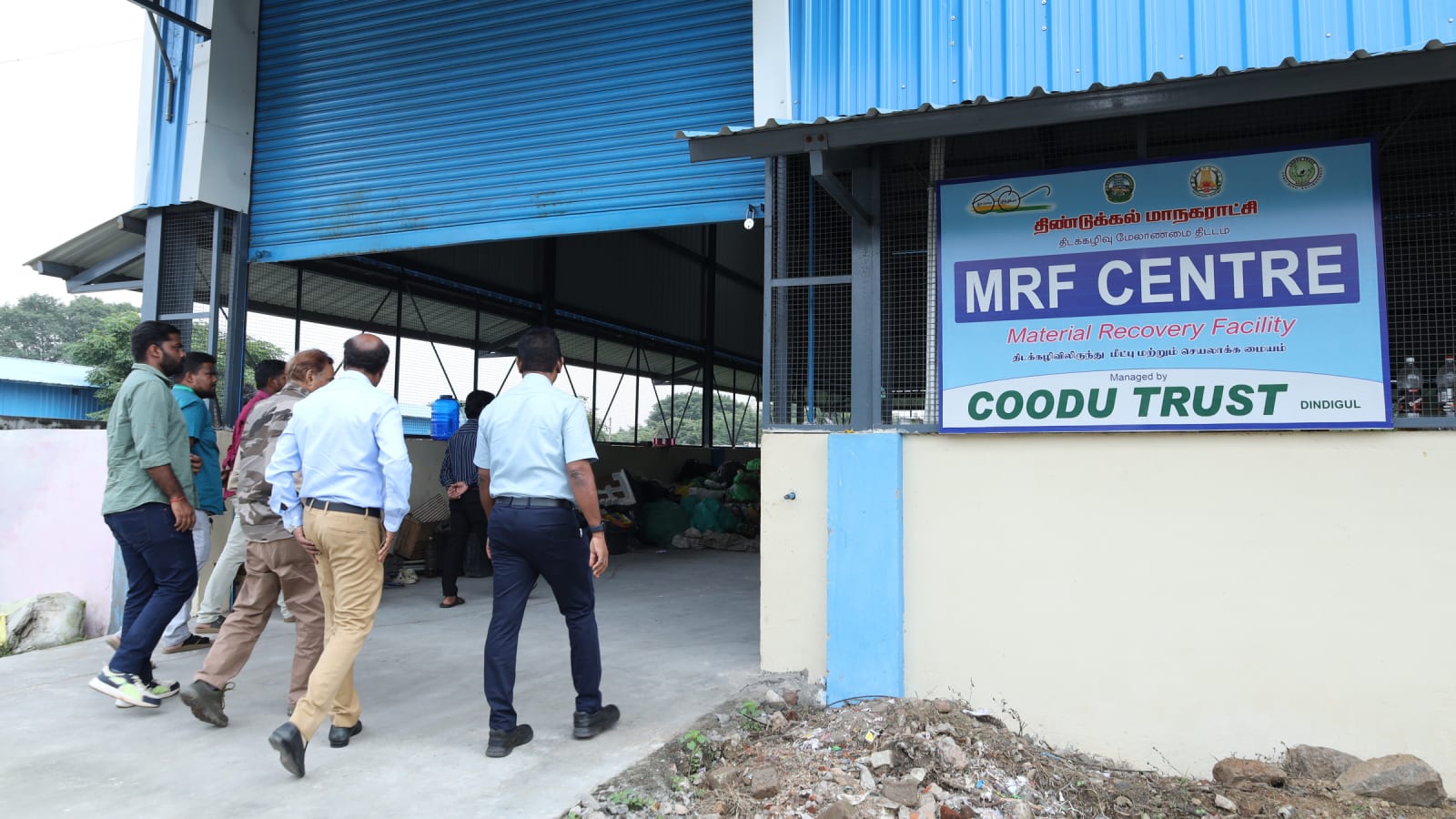
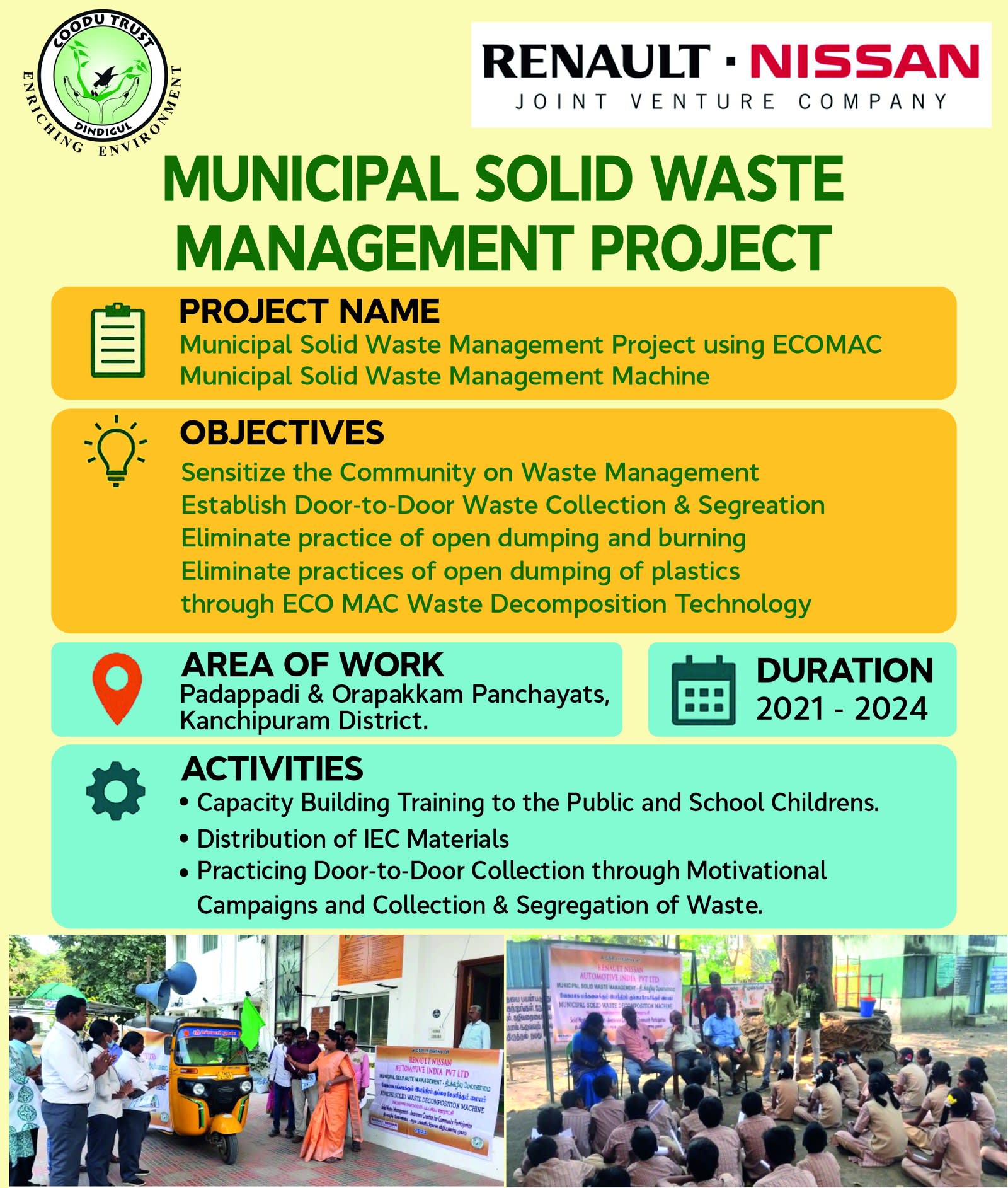
In the panchayats the model is decentralised. At Padappai Panchayat in Kancheepuram district, with the support of Renault P. Ltd, four to five tonnes of waste a day are collected from households and public spaces and processed through an ECOMAC decomposition machine that turns organic waste into compost for agricultural and horticultural use. In Dindigul, ITC Ltd has started Material Recovery Facility operations: household waste is segregated into wet and dry, and recyclable paper and cartons are baled and sent to ITC’s recycling unit in Coimbatore — seven metric tonnes of paper so far.
Why this work matters
Without reliable collection, municipal waste accumulates in residential areas — threatening public health across whole city wards.
Daily collection from households, streets and markets across 12 operational divisions of Dindigul City Municipal Corporation — 86 tonnes of waste handled every day, round the clock.
When wet, dry and hazardous waste travel together, nothing can be recovered — and the landfill burden keeps growing.
Waste is separated into degradable and non-degradable at the household, backed by regular awareness campaigns and door-to-door sensitisation with IEC materials, so that what is collected can actually be recovered.
Wet waste that could feed farmland rots in dumps — wasted as a resource and polluting the environment.
At Padappai, the ECOMAC decomposition machine turns the organic share of four to five tonnes a day into compost that goes back to agriculture and horticulture — waste recycled into a useful product rather than landfilled.
Waste work is too often done without proper equipment, training or care for the people who do it.
400 sanitary workers deployed across Dindigul’s divisions, and at Padappai comprehensive training for sanitary workers — sweepers, drivers and helpers — in segregation, composting and safe waste handling.
At a glance
Track record
| Programme | Period | Type | Highlights | Status |
|---|---|---|---|---|
| Solid Waste Management programme, Dindigul City Municipal Corporation | 2023–2025 | Municipal programme | 12 divisions, 400 sanitary workers, 86 tonnes a day, drainage maintenance, 24×7 | Ongoing |
| Padappai Panchayat waste collection & composting | 2023–2024 | CSR partnership | Renault P. Ltd — 4 to 5 tonnes a day through an ECOMAC decomposition machine, with household and school awareness | Completed |
| Material Recovery Facility, Dindigul | 2024–2025 | CSR partnership | ITC Ltd — wet and dry segregation; 7 metric tonnes of paper waste sent to ITC’s Coimbatore recycling unit | Ongoing |
| Koyambedu Market Complex solid waste services, Chennai | 2005–2007 | Advisory | Our energy and environment services division enabled a private enterprise to deliver SWM services at the market complex | Completed |
Impact
Daily door-to-door collection across 12 divisions of Dindigul keeps waste out of residential streets, markets and drains — and the operation runs 24×7, including at peak load.
86 tonnes a day segregated at source into degradable and non-degradable, then disposed of scientifically — with recyclable paper routed to ITC’s Coimbatore recycling unit instead of the dump.
At Padappai the ECOMAC machine converts organic waste into high-quality compost for agricultural and horticultural use — a circular economy at panchayat scale.
400 sanitary workers deployed across Dindigul, and at Padappai training for sanitary workers in segregation, composting and safe handling — plus jobs in collection and processing.
Get involved
Looking for solid waste management support for your municipality or panchayat? Coodu Trust runs city-scale operations in Dindigul and decentralised composting in Kancheepuram district, and can help build the same systems elsewhere.