Collective strength
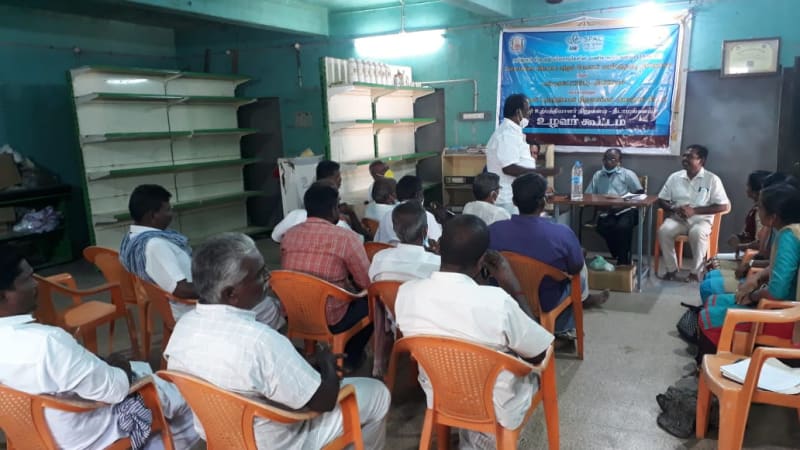
Organized 1,103 farmers into four producer companies and 500 women into a fifth, enabling better negotiation power and access to resources through group action.
Organizing farmers into self-help groups and cooperatives for enhanced income and sustainability.
Understanding
Farmer collectivization refers to organizing individual farmers into formal groups, cooperatives, or producer organizations to collectively undertake agricultural activities and achieve economies of scale.
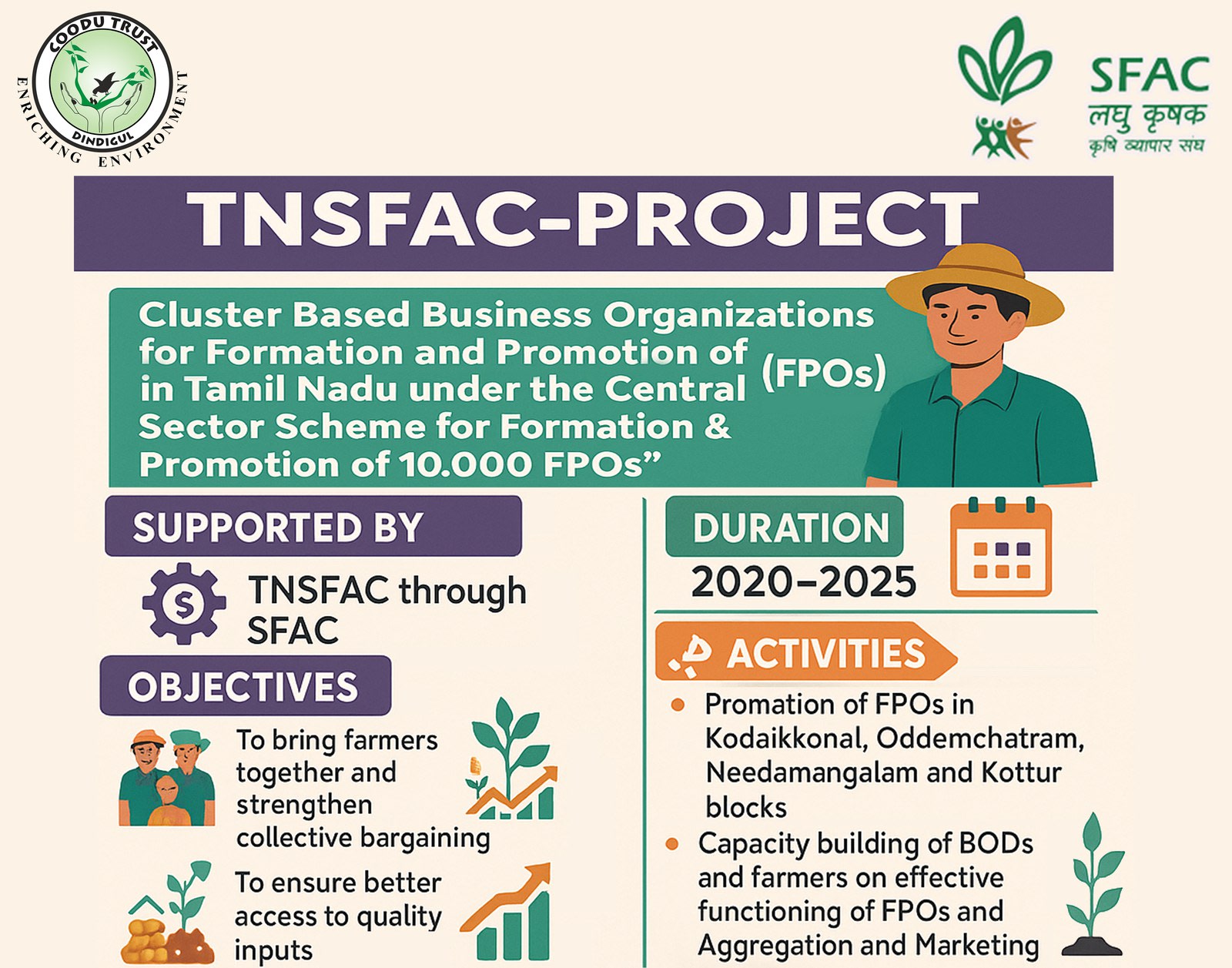
Our approach focuses on establishing Farmer Producer Companies (FPCs), Joint Liability Groups and agricultural cooperatives that empower farmers through collective bargaining, shared resources and integrated value chain development. Coodu Trust is empanelled as a Cluster-Based Business Organization (CBBO) by the Tamil Nadu Small Farmers Agri-Business Consortium (TNSFAC), and has promoted five producer companies — four in Dindigul and Thiruvarur districts with 1,103 farmers enrolled, plus the women-led Tharagampatti Dairy Farmers Producer Company in Karur.
We emphasize building sustainable business models that connect farmers directly to markets while providing access to credit, technology and quality inputs at competitive prices for enhanced income and sustainability.
Why this work matters
An individual farmer has little negotiation power and depends on intermediaries who take a cut of every sale.
Enrolling 1,103 farmers into four producer companies, and 500 women dairy farmers into a fifth, gives them negotiation power, collective marketing and better price realization with less dependence on intermediaries.
Buying seed, feed and equipment individually leaves smallholders paying more for lower-quality inputs.
Group purchasing and negotiation with suppliers give members access to quality inputs at competitive prices — plus shared machinery through collective ownership models.
On their own, small farmers struggle to access formal credit systems and financial services.
Collective guarantee and group lending models improve access to formal credit and financial services for every member.
Selling unprocessed produce means the value addition — and the profit — happens somewhere else.
Farmer-owned processing units and integrated value chains keep value addition, product development and market positioning in farmers' hands.
At a glance
Track record
| Programme | Period | Type | Highlights | Status |
|---|---|---|---|---|
| Promotion of FPOs (10,000 FPO scheme) | 2021–2025 | National scheme | Four FPOs promoted as a CBBO empanelled by TNSFAC; 1,103 farmers enrolled | Ongoing |
| Dairy Development Programme (CSR — Karur Vysya Bank) | 2021–2025 | CSR partnership | Tharagampatti Dairy FPC — 500 women members, 10 collection centres | Ongoing |
| Farmer Producer Organisation (FPO) promotion | 2015–2016 | Key activity | Awareness in 10 villages of 3 blocks, Dindigul; about 600 farmers benefited | Completed |
Impact
Organized 1,103 farmers into four producer companies and 500 women into a fifth, enabling better negotiation power and access to resources through group action.
Promoted five farmer producer companies, all of which have secured equity grants and begun trading in garlic, maize, paddy, groundnut, copra, onion, cotton and milk.
Developed integrated value chains combining livestock development with farmer producer company models for comprehensive growth.
Created direct market linkages and improved price realization through collective marketing and reduced intermediary dependency.
Get involved
Join us in building strong farmer collectives and sustainable agribusiness enterprises that empower rural communities and create lasting economic opportunities. Your support helps farmers organize, access markets, and build prosperous agricultural businesses.