Economic empowerment
Women have moved from subsistence farming to agri-entrepreneurship — dairy income averaging ₹34 per litre with weekly payments has improved the economic status and financial independence of women farmers and their families.
A CSR partnership with Karur Vysya Bank, originated under the State Balanced Growth Fund — building a women-led dairy producer company at Kadavur Block, Karur District, Tamil Nadu.
The project
Supporting the economic empowerment of women farmers through collective action in dairy farming, by establishing a women-led Farmer Producer Company, creating milk collection infrastructure, and providing comprehensive training in dairy management, fodder cultivation, and para-veterinary services — transforming women from subsistence farmers into agri-entrepreneurs.
The programme originated under the State Balanced Growth Fund (SBGF), a State Planning Commission programme addressing regional imbalances in per capita income, employment, poverty, health, education and gender issues. The Commission identified Coodu Trust as the coordinating agency for the “Sustainable Livelihood Enhancement through Scientific Management of Dairy Animals” project at Kadavur Block, Karur District — with Karur Vysya Bank layering CSR support, including a dedicated milk transport vehicle.
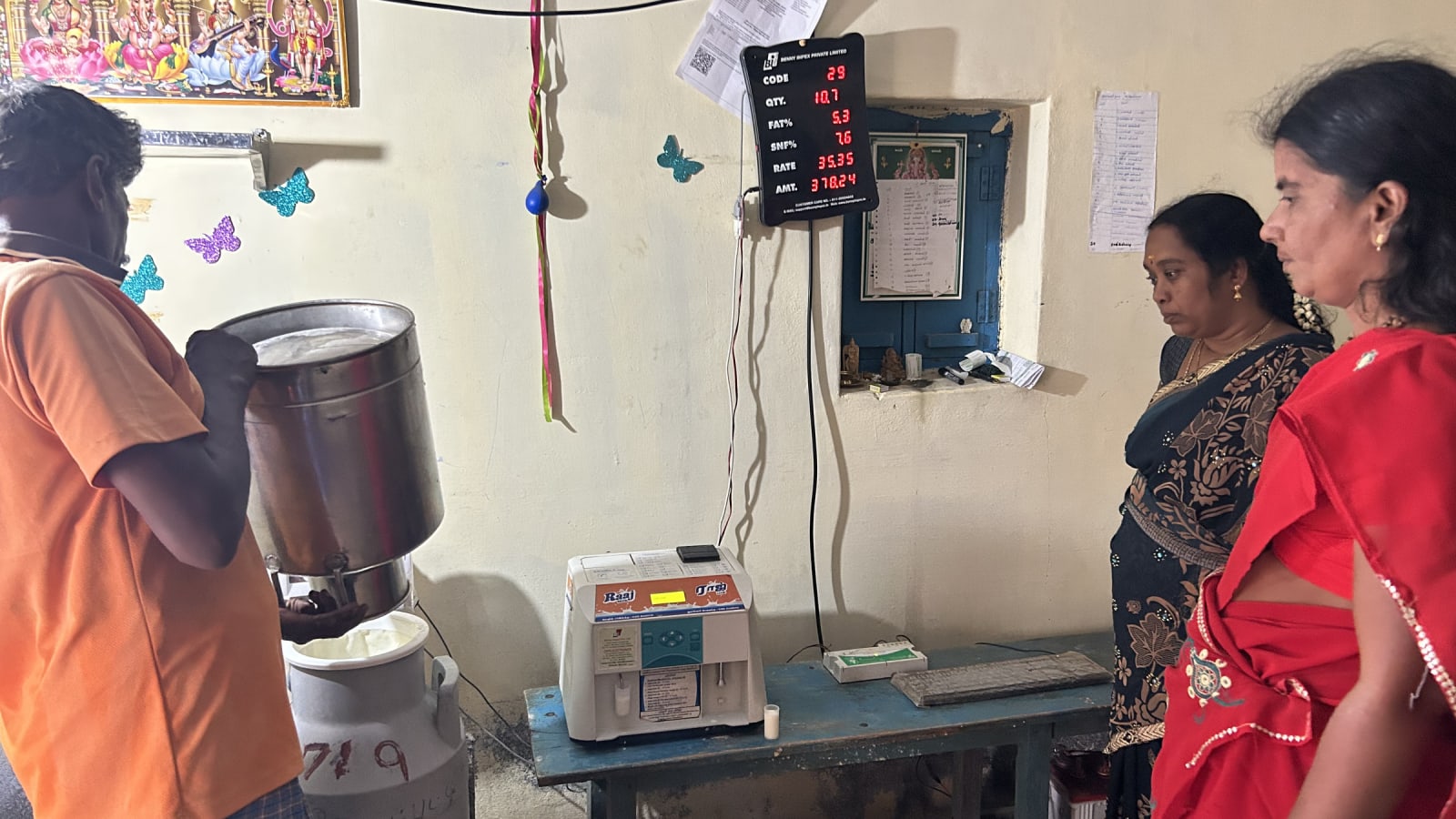
At its centre is the Tharagampatti Dairy Farmers Producer Company Limited (TDPCL): 500 women farmers enrolled as members and 100 Joint Liability Groups formed in the block. Ten milk collection centres were handling 1,800 litres a day in 2021–22 and 1,500 to 1,700 litres in 2023–24, marketed through Raj Dairy at ₹32 to ₹45 per litre based on SNF (Solids-Not-Fat) value, with weekly payments to every producer.
Training runs alongside the infrastructure: 260 women trained in dairy farming (2021–22), 100 women in fodder and Azolla cultivation and 20 youth through a 30-day para-veterinary programme with the Veterinary Department (2023–24), then 10 rural youth trained for a month in artificial insemination and 40 women taken on exposure visits to the TANUVAS institutes at Karur and Namakkal (2024–25).
Why this work matters
Individual subsistence farmers have no collective bargaining power — leaving women vulnerable to market fluctuations, with no assured price or steady buyer for their milk.
TDPCL organises 500 women through 100 JLGs and 10 collection centres, marketing collectively via Raj Dairy at ₹32–45 per litre on SNF value — with weekly payments to every beneficiary.
When veterinary care sits outside the community, feeding practices, vaccination schedules and disease prevention are hard to sustain — and herd health and milk yield suffer.
Training in livestock management, animal nutrition, vaccination schedules and disease prevention — plus a 30-day para-veterinary programme for 20 local youth with the Veterinary Department.
At a glance
Outcomes
Women have moved from subsistence farming to agri-entrepreneurship — dairy income averaging ₹34 per litre with weekly payments has improved the economic status and financial independence of women farmers and their families.
Training in fodder cultivation, Azolla farming and veterinary care has produced healthier cows and better milk yield — farmers reported a 15–20% increase in yield in 2024–25 after the Azolla and Super Napier fodder units were established, and a ₹1.70 crore loan enabled the purchase of 400 high-yield milch animals.
TDPCL’s collection centres and collective marketing via Raj Dairy give women farmers better prices and a steady market — a support network, wholly women-led, that makes them less vulnerable to market fluctuations.
Get involved
Help us grow producer companies like TDPCL — where collective milk marketing, fair SNF-based prices and local para-veterinary skills turn women farmers into agri-entrepreneurs.