Integrated Watershed Management Programme

A programme of the Department of Land Resources, Ministry of Rural Development — Coodu Trust worked on it first as a consultant to the Joint Director of Agriculture and later as a coordinating agency for community capacity building, alongside the District Watershed Development Agency.

  • Central government scheme
  • 2011–2023
91 Watersheds in 2022–2023
21 Blocks across 7 districts
6,847 Community members trained
42,838 Beneficiaries recorded in 2017–2018

The project

Restoring degraded landscapes, watershed by watershed

Project mission

Restore the ecological balance of degraded landscapes by treating watersheds in a holistic and integrated manner — harnessing, conserving and developing soil, water and vegetative cover to prevent soil erosion, regenerate vegetation, harvest rainwater and recharge the groundwater table.

The Integrated Watershed Management Programme (IWMP) is run by the Department of Land Resources, Ministry of Rural Development, Government of India, and has been under implementation since 2010–11. Coodu Trust’s first recorded engagement was in 2011–12 as a consultant on a ₹18,00,000 assignment for the Joint Directors of Agriculture in Karur, Namakkal, Tirunelveli and Tiruvallur — entry point activities, IEC awareness, Participatory Rural Appraisal and action planning, district-level capacity building for watershed user groups and SHGs, and convergence with the government line departments.

In later years the Trust worked as a coordinating agency on community organisation and training, in partnership with the District Watershed Development Agency (DWDA). The 2017–18 report records 42,838 beneficiaries across fifteen districts, led by Salem (7,400), Dharmapuri (5,569) and Tiruvallur (4,580). The 2018–19 report puts the work in eight districts; the 2019–20 report names Pudukkottai, Thoothukudi, Salem and Tiruvanamalai.

The most detailed recent account is from 2022–23, when training and exposure visits at KVK Gandhigram, TNAU Coimbatore, TNAU Killikulam and Horticulture College Periyakulam reached 6,847 members of watershed committees, SHGs and beneficiary households across 91 watersheds in 21 blocks of seven districts — Dindigul, Virudhunagar, Thoothukudi, Perambalur, Ramanathapuram, Dharmapuri and Krishnagiri.

  • Community participation
  • Sustainable agriculture
  • Institution building
  • Livelihood enhancement
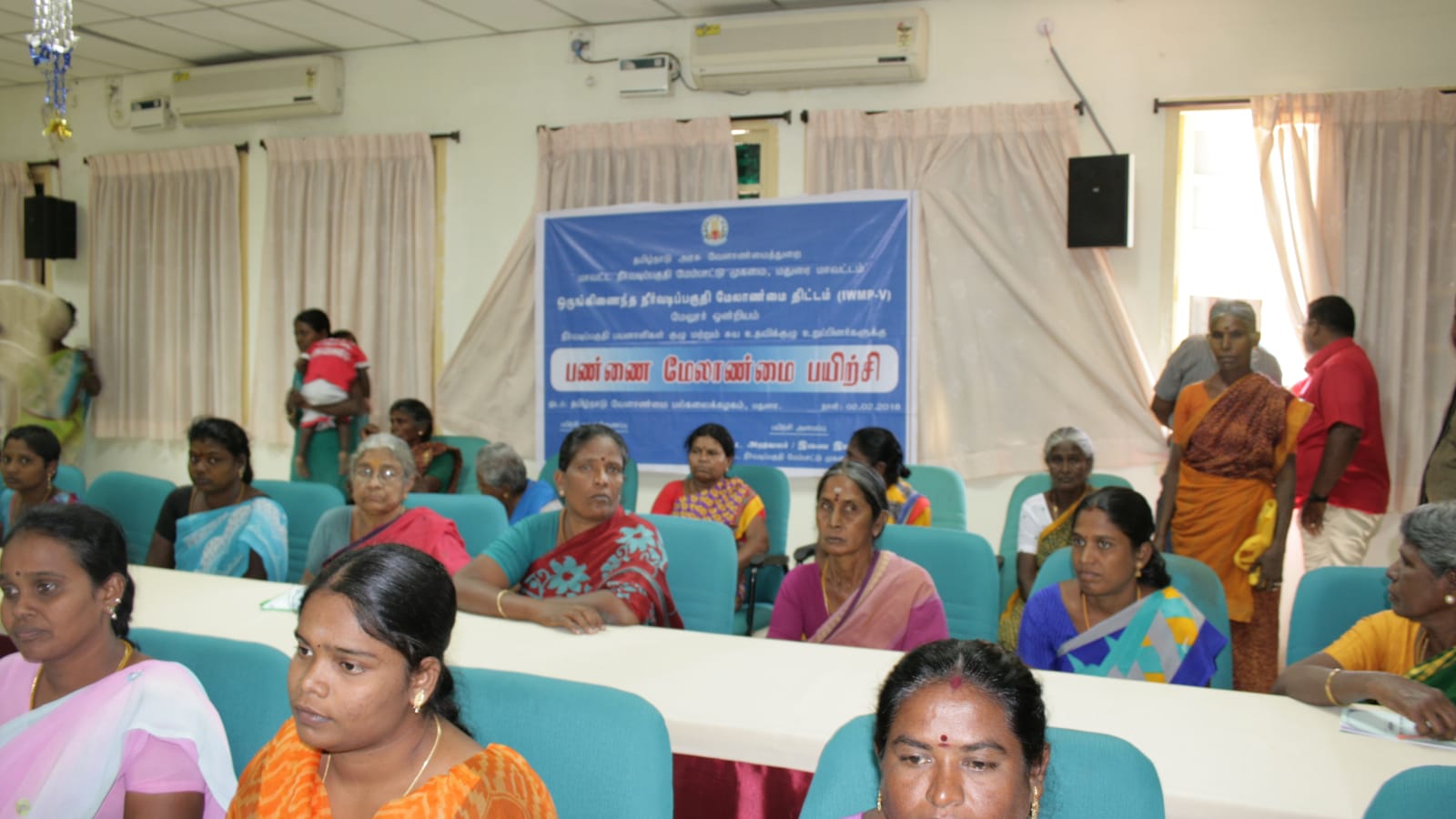
Rows of women trainees seated at tables in an auditorium, several faces in the front rows sharp and attentive
Women trainees at a watershed capacity-building session.

Why this work matters

The challenge on the ground — and our answer

The challenge

Degraded land losing its soil and water

On degraded landscapes, rain runs off instead of soaking in — eroding topsoil, stripping vegetative cover and leaving the groundwater table unreplenished.

Our response

Planning the watershed with the village in it

Participatory Rural Appraisal in each micro-watershed, an action plan built from land capability and local need, and convergence with the Agriculture, Horticulture and Agricultural Engineering departments so the treatment is funded and maintained.

The challenge

Livelihoods tied to a single fragile harvest

When households depend on one crop from degraded land, incomes stay low and every failed season pushes families deeper into hardship.

Our response

Diversified, sustainable livelihoods

Training on water management, pest management, organic farming, vermicomposting and micro-irrigation, with exposure visits to Jain Irrigation Udumalpet, Tirupathi and Kudimiyanmalai — 525 farmers on site in 2021–22 alone.

At a glance

The essentials

Scheme
IWMPIntegrated Watershed Management Programme — Department of Land Resources, Ministry of Rural Development, Government of India; under implementation since 2010–11
Period
2011–2023Recorded in seven annual reports: 2011–12, 2017–18, 2018–19, 2019–20, 2021–22, 2022–23 and 2023–24
Coverage
91 watersheds, 7 districts2022–23: Dindigul (23 watersheds), Virudhunagar (32), Thoothukudi (20), Perambalur (6), Dharmapuri (4), Krishnagiri (3) and Ramanathapuram (3), across 21 blocks
Beneficiaries
6,847 members trainedWatershed committee members, beneficiaries and SHG members in 2022–23. The 2017–18 report records 42,838 beneficiaries across fifteen districts.
Our role
Consultant, then coordinating agency2011–12: consultant to the Joint Directors of Agriculture, Karur / Namakkal / Tirunelveli / Tiruvallur, on a ₹18,00,000 assignment. 2021–23: coordinating agency for community organisation and training with the District Watershed Development Agency.
Part of
Watershed portfolioOne of 6 government watershed programmes worked on since 2001

Outcomes

What the project changed

Extensive geographical coverage

The 2017–18 report records IWMP beneficiaries in fifteen districts — Salem, Dharmapuri, Tiruvallur, Erode, Kancheepuram, Sivagangai, Krishnagiri, Virudhunagar, Pudukottai, Ramnad, Tirunelveli, Madurai, Theni, Villupuram and Karur.

Significant community impact

42,838 beneficiaries recorded in 2017–18; 3,021 farmers trained and 525 taken on exposure visits in 2021–22; 6,847 community members trained across 91 watersheds in 2022–23.

Resilience building

By strengthening community-based institutions and promoting sustainable agro-based activities, IWMP enhances household incomes and builds long-term environmental and economic resilience.

Get involved

Help restore degraded landscapes

Support watershed work that conserves soil and water, recharges groundwater and builds sustainable livelihoods for rural communities across Tamil Nadu.